How we calculate this
- Bag yields are from the Quikrete Concrete Mix data sheet: 40 lb 0.30 cu ft, 50 lb 0.375, 60 lb 0.45, 80 lb 0.60 and 90 lb 0.675. Other brands are close but not identical, so check the bag.
- Mixing water uses Quikrete’s range per bag (6 to 9 pints for an 80 lb bag).
- Forms use the smallest board at least as tall as the slab is thick (a 2x4 is only 3 1/2 in tall, a 2x6 is 5 1/2 in, per NIST PS 20), in stock lengths. Stakes go roughly every 3 ft plus the corners.
- Rebar runs both ways at your spacing, cut from 20 ft sticks. Bars stop 3 in from the edges, the code’s cover for concrete cast against the earth (R403.1.3.5.3). Where a bar is longer than a stick, the pieces overlap 30 in, the code’s lap for Grade 60 #4 bars (Table R608.5.4(1); Grade 40 needs 20 in). Both rules are written for footings and walls; the IRC sets no rebar spacing for a shed slab, so the 18 in default is a placeholder to confirm with your building department.
- Wire mesh comes in 5 × 10 ft sheets with a 6 in grid. Sheets overlap one grid square plus 2 in (ACI 439.5R, as published by the American Society of Concrete Contractors), so each sheet covers about 40 sq ft.
- Ready-mix is the same volume plus waste, rounded up to a quarter yard. It’s shown as an alternative and left out of the total.
Worked example: how much concrete for a 10 × 12 shed slab?
A 12 ft × 10 ft shed slab, 4 in thick, on 4 in of gravel:
- Volume: 12 × 10 × 4 ÷ 12 = 40 cu ft, or 1.48 cu yd.
- With 10% waste: 44 cu ft ÷ 0.6 = 74 bags of 80 lb. That’s 5,920 lb to haul and 56 to 83 gal of mixing water.
- Or ready-mix: 1.75 cu yd.
- Gravel: 1.7 cu yd. Forms: 4 2x6 boards and 19 stakes. Rebar: 11 sticks at 18 in.
- Joints: 2 control joints, splitting the slab into 4 panels of about 6 ft × 5 ft.
Safety and when to call a pro
Wet concrete is caustic. Quikrete’s data sheet warns it causes severe skin burns and eye damage and that the dust can harm your lungs: wear impervious gloves (such as nitrile), eye protection and a mask. A slab this size is a lot of material to mix and finish before it sets, so line up helpers or a mixer.
This calculator is for a simple shed floor. Garages, house additions and slabs that carry walls or heavy equipment need footings and reinforcement designed to your local code. A shed over 200 sq ft usually needs a building permit.
Numbers this calculator uses
Every value comes from the data files behind this page. Anything marked PLACEHOLDER hasn’t been checked against a source yet, and you can override it in the calculator where it matters.
| Number | Value | Source |
|---|---|---|
| Cubic feet in a cubic yard | 27 | Unit definition |
| Minimum slab-on-ground thicknessR506.1. | 3 1/2 in | 2024 IRCchecked 2026-10-30 |
| Gravel base under a below-grade slabR506.3.2: not required on well-drained Group I soils. | 4 in | 2024 IRCchecked 2026-10-30 |
| Largest one-story detached building exempt from a permitR105.2. Local rules can be stricter. | 200 sq ft | 2024 IRCchecked 2026-10-30 |
| Rebar grid spacing (default)Not set by the IRC for a shed slab. Ask your building department or follow your plans. | 18 in | PLACEHOLDER |
| Rebar distance from slab edgesR403.1.3.5.3: 3 in of cover for concrete cast against the earth. That rule is written for footings; we use it for slab edges too. | 3 in | 2024 IRCchecked 2026-10-30 |
| Rebar stick length#4 rebar is sold in 20 ft sticks (also 10 ft). | 20 ft | The Home Depotchecked 2026-10-30 |
| Rebar overlap where bars joinTable R608.5.4(1): #4 bars lap 30 in for Grade 60 steel, 20 in for Grade 40. We use 30 in so it works for either. The table is written for concrete walls. | 30 in | 2024 IRCchecked 2026-10-30 |
| Wire mesh sheet width | 5 ft | Kuhlmanchecked 2026-10-30 |
| Wire mesh sheet length | 10 ft | Kuhlmanchecked 2026-10-30 |
| Wire mesh grid spacing | 6 in | Kuhlmanchecked 2026-10-30 |
| Wire mesh lap beyond one grid squareACI 439.5R-18 section 6.4, as quoted by ASCC: lap one square plus 2 in, so 8 in for 6 x 6 mesh. | 2 in | American Society of Concrete Contractorschecked 2026-10-30 |
| Form stake spacing | 3 ft | PLACEHOLDER |
| Bagged paver base volume | 0.5 cu ft | The Home Depotchecked 2026-10-31 |
| Waste factor for concrete and gravel (default; you can change it)Covers uneven ground, spills and form bulge. Gravel also settles when compacted. | 10% | PLACEHOLDER |
| Concrete mix yield per bag | 40 lb: 0.3 cu ft; 50 lb: 0.375 cu ft; 60 lb: 0.45 cu ft; 80 lb: 0.6 cu ft; 90 lb: 0.675 cu ft | The Quikrete Companieschecked 2026-10-30 |
| Thinnest pour the mix is designed for | 2 in | The Quikrete Companieschecked 2026-10-30 |
| Control joints at most everyQuikrete: every 6 to 8 ft. | 8 ft | The Quikrete Companieschecked 2026-10-30 |
| Control joint depth | 1 in | The Quikrete Companieschecked 2026-10-30 |
| Form board heights | 2x4: 3 1/2 in; 2x6: 5 1/2 in; 2x8: 7 1/4 in; 2x10: 9 1/4 in; 2x12: 11 1/4 in | National Institute of Standards and Technologychecked 2026-10-30 |
Sources
| Source | What we use from it | Last checked |
|---|---|---|
| QUIKRETE Concrete Mix No. 1101 data sheet (revised October 2022)The Quikrete Companies · manufacturer spec | Bag yields (40 lb 0.30 cu ft, 50 lb 0.375, 60 lb 0.45, 80 lb 0.60, 90 lb 0.675), mixing water per bag, minimum pour thickness of 2 in, control joints every 6 to 8 ft, fence post hole size (3x the post width, 1/3 of the post's length deep, 6 in of mix under the post). | 2026-10-30 |
| 2024 International Residential Code, Chapter 5 (Floors): R506 and R507International Code Council · building code | Slab thickness (R506.1), base course (R506.3.2), vapor retarder (R506.3.3), deck beam spans (Tables R507.5(1)-(4)), deck joist spans and cantilevers (Table R507.6), decking joist spacing and fastening (R507.7). | 2026-10-30 |
| 2024 International Residential Code, Section R105.2 (Work exempt from permit)International Code Council · building code | Permit exemptions: fences up to 7 ft, retaining walls up to 4 ft (bottom of footing to top of wall, no surcharge), detached accessory buildings up to 200 sq ft, small low unattached decks. | 2026-10-30 |
| 2024 International Residential Code, Section R403.1.3.5.3 (Support and cover)International Code Council · building code | Reinforcement in concrete cast against the earth needs at least 3 in of cover (written for footings; we use it to keep slab bars 3 in from the edges). | 2026-10-30 |
| 2024 International Residential Code, Table R608.5.4(1) (Lap splice and tension development lengths)International Code Council · building code | #4 bars lap 20 in for Grade 40 steel and 30 in for Grade 60 (written for concrete walls). | 2026-10-30 |
| Voluntary Product Standard PS 20-10, American Softwood Lumber Standard, Table 3National Institute of Standards and Technology · standard | Actual (dressed, dry) sizes of nominal lumber: 1x6 is 3/4 x 5-1/2 in, 5/4 boards are 1 in thick, 2x lumber is 1-1/2 in thick, 4x4 is 3-1/2 in, 6x6 is 5-1/2 in. | 2026-10-30 |
| Southern Pine specification guidelinesSouthern Pine Council · industry guide | Dimension lumber is specified in standard lengths from 8 to 20 ft in 2 ft steps. | 2026-10-30 |
| 1/2 in x 20 ft #4 rebar (REB/4/615G4/20), Home Depot listingThe Home Depot · store listing | #4 rebar sold in 20 ft sticks of Grade 40 steel. | 2026-10-30 |
| 10-gauge wire mesh, 5 ft x 10 ft sheet, 6 x 6 in spacing, Kuhlman listingKuhlman · store listing | Welded wire mesh sold in 5 x 10 ft sheets with a 6 x 6 in grid. | 2026-10-30 |
| WWR Lap Splice Requirements (The Voice, January 2021)American Society of Concrete Contractors · industry guide | Cites ACI 439.5R-18 section 6.4: lap plain welded wire mesh one grid square plus 2 in. | 2026-10-30 |
Spotted a number that’s out of date? Tell us and we’ll recheck it and note the fix in the change log.
Frequently asked questions
How many 80 lb bags of concrete make a cubic yard?
About 45. A cubic yard is 27 cu ft and an 80 lb bag of Quikrete Concrete Mix makes about 0.6 cu ft, so 27 ÷ 0.6 = 45. With 60 lb bags (0.45 cu ft each) it’s 60. Add a little for waste.
How thick should a shed slab be?
The 2024 IRC’s minimum for a concrete slab floor is 3.5 in (R506.1). Your building department may require more for a shed that will hold a riding mower, a vehicle or heavy shelving, and a slab that carries walls needs footings designed to local code.
Do I need gravel under a concrete slab?
The code calls for a 4 in base of clean graded sand, gravel or crushed stone under slabs below grade, unless the soil is already well-drained sand or gravel (R506.3.2). Compact it before you pour.
Do I need a vapor barrier under a shed slab?
The 2024 IRC doesn’t require one under garages, utility buildings and other unheated accessory structures (R506.3.3). If you’ll store things that mind damp, you can still add 6-mil polyethylene, lapped at the joints.
Should I use bags or order ready-mix?
Compare the two lines in the cost estimate with your local prices. Bags are easy to buy but heavy: the weight to haul is shown with the results. Ready-mix plants often have minimum orders and short-load fees, so ask before you choose.
Where do control joints go?
Quikrete’s instructions call for joints about 1 in deep every 6 to 8 ft. The calculator splits each side into equal panels no more than 8 ft across and draws the joint lines on the diagram.
Save this plan
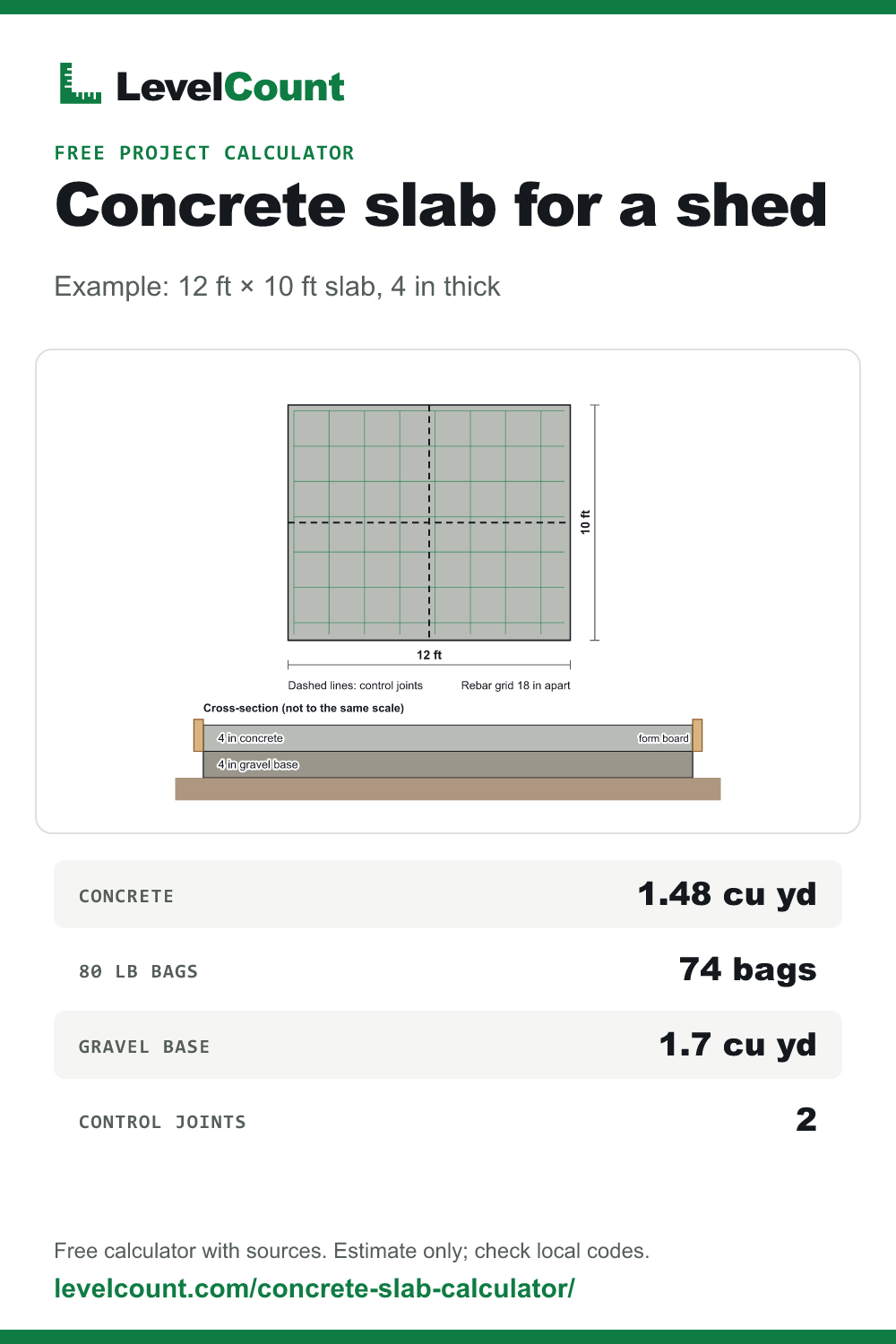
This card shows the example on this page. Use Download summary image above to make one with your own numbers, or pin this one to come back to the calculator later.